Other Notes
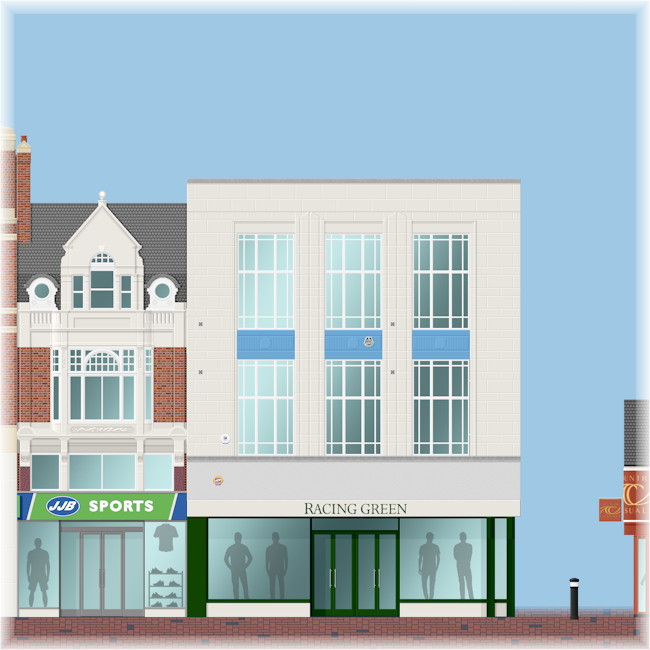
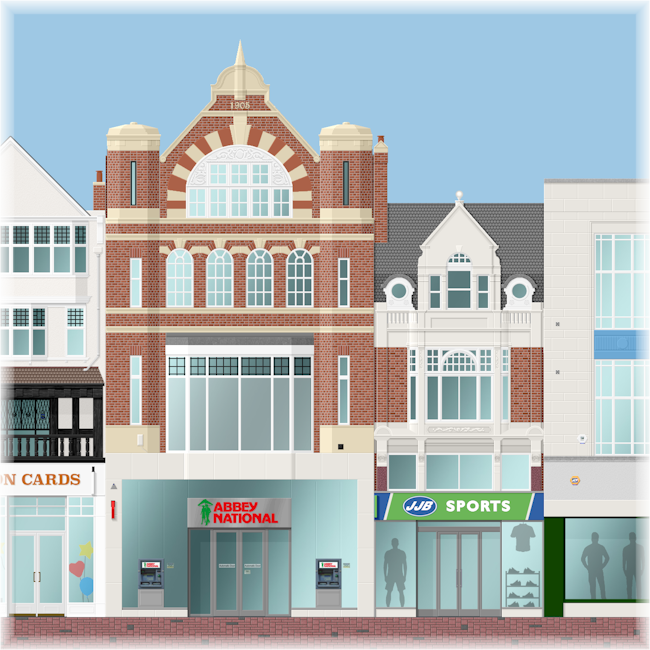
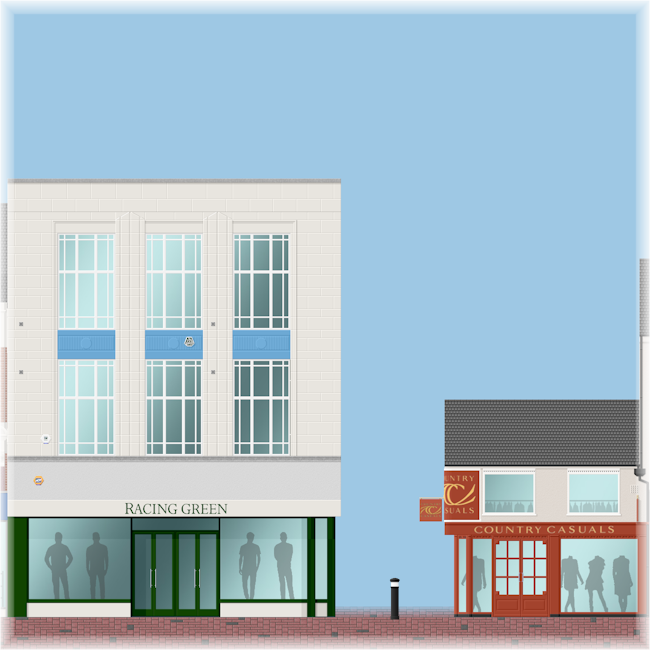
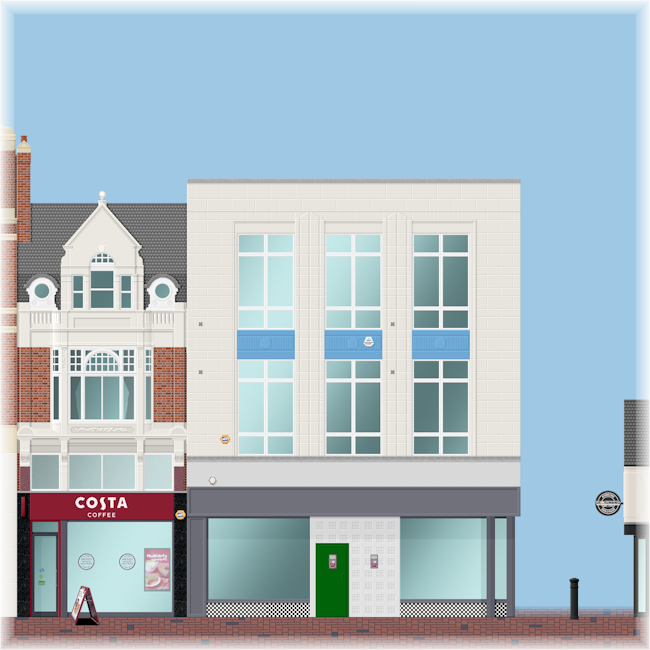
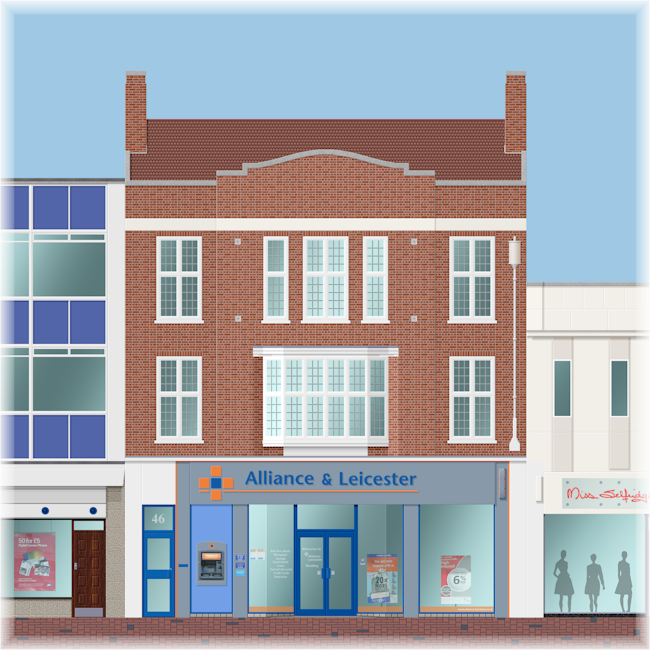
Scene Showing Nos. 97-99
No images of Racing Green at Nos. 97-98 were available, so its appearance is based on the building and the design of other Racing Green stores at the time.
Broad Street
Reading's main shopping street, Broad Street was laid out shortly after the foundation of Reading Abbey in 1120. It appeared as 'Brode Stret' on John Speed's map of 1611 and hosted the Glorious Revolution's only battle in 1688. Until 1862, its eastern end comprised two narrow, parallel streets - Butcher Row & Fisher Row.
The western part of Broad Street was pedestrianised in 1992. Re-paving with red brick to more clearly delineate pedestrian areas was completed in 1994. This also fixed the problem of increasingly uneven paving on the former pedestrian pavement, which would have needed replacement anyway.
Reading
Reading is a town in the English county of Berkshire. It is regarded as the county town although, since the county council was abolished in 1998, that is a distinction of traditional rather than practical significance. It is the UK's largest town, having been denied official city status no less than four times - in 2000, 2002, 2012 and 2022. As such, it remains a borough, and has held that status since at least the time of the Domesday Book in 1068. A royal charter, granting independence from control by Reading Abbey, was issued in 1253. A second charter was issued in 1542, reflecting the abbey's dissolution in 1538. Since 1998, the borough has been a unitary authority.
How to use Gone Shopping
Use the blue buttons above to navigate up and down the street.

Go to left end of street
This will take you to the scene containing the leftmost building on the side of the street that you are facing.

Go to middle of street
This will take you to a scene that is approximately halfway along the side of the street that you are facing.

Go to right end of street
This will take you to the scene containing the rightmost building on the side of the street that you are facing.

Open street map
This will take you to a page displaying a clickable street map from which you may navigate to a selection of scenes along this street.

Go to next left
This will shift you leftwards down the street by one scene.

Go forward
This would let you move forward into an adjoining street. However, there is not yet another street available for you to do that.

Face other side of street
This will turn you about 180° so that you are facing a scene on the opposite side of the street.

Go to next right
This will shift you righttwards down the street by one scene.
The yellow buttons navigate through time.

Open year selector
This will take you to a page displaying all the years that are currently available for the scene that you are looking at, any one of which may be clicked to navigate to that year.

Go to earliest year available
This will take you to the first year available for the scene that you are currently looking at.

Go to previous year
This will take the scene that you are currently looking at back one year in time. (This may or may not look any different depending on whether anything changed between those two years).

Go to next year
This will take the scene that you are currently looking at forward one year in time. (This may or may not look any different depending on whether anything changed between those two years).

Go to latest year available
This will take you to the most recent year available for the scene that you are currently looking at.
Building & Occupier Details

Building:
No. 99, Broad Street
This building has been around since at least the 1890s and probably dates back to 1882, when it was occupied by hatters and hosiers Thomas Reed & Son.

No. 99
JJB Sports (sports retailer)
JJB Sports was a sports retailer founded in Wigan in 1903 by John Jarvis Broughton. Former footballer Dave Whelan acquired the shop in 1971 and grew it into a chain of 430 stores. It narrowly avoided administration in 2009 and was bought by Sports Direct in 2012.


Building:
Former Burton building II (late 1930s)
This building was erected in the late 1930s for menswear firm Burton. It either fully-replaced or refaced and reworked the old General Post Office erected in 1878. This occurred at some time after 1936, when a second Burton branch was opened at Nos. 73-74.

Nos. 97-98, Ground Floor
Racing Green (clothing retailer - menswear)
Racing Green is a menswear brand founded in 1991 by David Krantz and named after the classic colour of British racing cars. It was sold to Burton Group in 1996 who divested it as part of Rubicon Retail in 2002. They then sold it to Speciality Retail Group in 2003, which was then acquired by Baird Group in 2009.


Nos. 97-98, 1st Floor
Kelly Services (recruitment agency)
Kelly Services is an American recruitment and temping agency founded in 1946 by WIlliam Russell Kelly. Its UK subsidiary was established in 1992 and was sold to Italy's Gi Group, along with all of Kelly's other European operations, in 2024. Gi Group then absorbed and rebranded its acquisition.

Junction:
Junction with Chain Street
Chain Street has led south from Broad Street since mediaeval times. It connects to Minster Street and Gun Street and has always been narrow.

South to
Chain Street
Chain Street has been called that since at least 1611, when John Speed labelled it 'Chayne Lane' on his map. The chain in question was hung across its entrance to stop horses from entering St Mary's churchyard. Prior to that, as in Roger Amyce's survey of 1552, the street was known as Grope Lane.
 Home
Broad St
Q&A
Icons
Progress
Cookies
Home
Broad St
Q&A
Icons
Progress
Cookies